
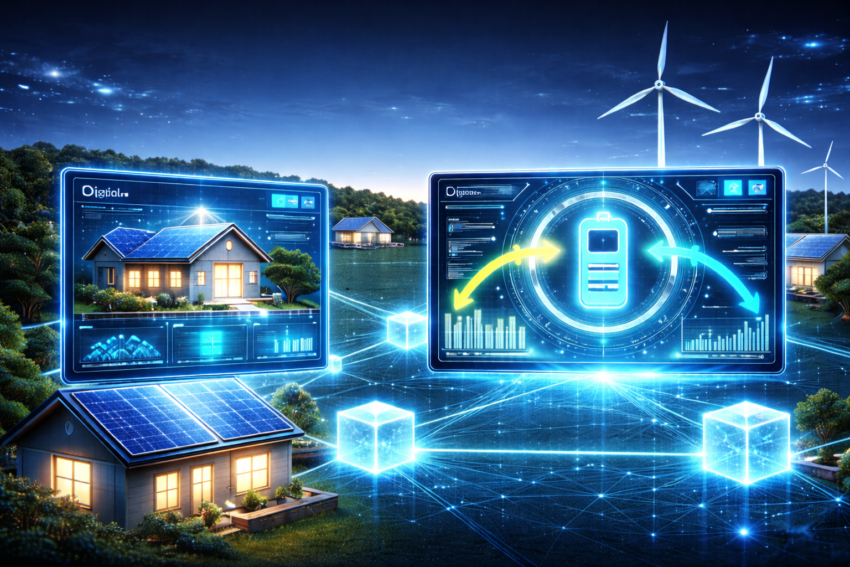
Direct, automated energy swaps between neighbors inside a local grid, settled on-chain, without a central retailer.
Got surplus rooftop solar at noon? Want cheaper kWh at 7 pm? In an urban microgrid, prosumers post offers/bids; smart contracts clear trades using live meter data. Settlement is near real time. No call centers. Just tokens and kilowatt-hours.
Core flow:
Prosumer A (PV) -> Smart Meter -> Oracle -> Smart Contract -> Prosumer B (Load)
price/time rules, grid limits enforced
Think transactive energy meets DeFi:
- Assets: DERs (rooftop PV, batteries, EVs)
- Market: P2P orderbooks or auctions, time-of-use aware
- Ledger: permissioned chains (Energy Web, Hyperledger) or L2 Ethereum
- Tokens: kWh credits, REC/NFC certificates, staking for reliability
- Constraints: feeder capacity, locational pricing, curtailment
Why care? Lower bills, monetized solar, resilience, decarbonization, community ownership.
Risks? Regulation, meter tampering, oracle attacks, privacy, UX friction, congestion fees. Skeptical? Look at Brooklyn Microgrid, Power Ledger pilots, Ofgem sandboxes.
How does the technical architecture map on-chain and off-chain for urban energy markets?
On-chain secures value, rights, and provenance; off-chain handles high-frequency telemetry, control, and optimization—bridged by verifiable oracles and rollups.
- Data plane (off-chain): AMI smart meters, EV chargers (OCPP/OCPI), DER inverters, and building EMS push MQTT/OPC-UA streams to edge gateways. Kafka/TimescaleDB crunches second-by-second kW, voltage, and carbon-intensity. Why force a blockchain to sample at 1 Hz?
- Settlement plane (on-chain): tokenized kWh and RECs (ERC-20/1155), prosumer identities (DIDs), and P2P trades via auctions or AMMs. Finality means accountability—and bankable cashflows.
- Trust bridge: ZK proofs attest meter readings and baseline compliance; oracles batch readings; L2 rollups compress trades; state channels handle sub-minute balancing.
- Coordination: OpenADR demand response, flexibility bids for DSO/TSO, microgrids netting internally, public chains anchoring state.
Risks? Oracle capture, data tampering, latency in grid contingencies. Opportunity? Autonomous neighborhoods trading clean power with auditable impact. Who controls energy now—you or your utility?
How do prosumers, smart meters, and IoT identities connect to blockchain?
Prosumers use smart meters with cryptographic identities to sell excess energy peer-to-peer, with blockchain settling payments and proving data integrity.
Why should your rooftop solar wait for a utility’s batch invoice? A smart meter signs each kWh reading with its IoT DID (decentralized identifier) and streams it via MQTT to an edge gateway. The gateway anchors hashes on-chain, while raw data stays off-chain for privacy. Buyers in a microgrid match bids/asks; stablecoins or energy tokens settle instantly.
Mini diagram:
Solar → Smart Meter (TPM key) → Edge Gateway → Hash on-chain + data off-chain → AMM/auction → Wallets settle
Definitions:
- DID: Portable device identity using public/private keys.
- Verifiable Credential: Attestation that a meter is certified/calibrated.
- Device wallet: Key in secure enclave for signing and receiving funds.
Tech options: Energy Web Chain, IOTA, Polygon + oracles, LoRaWAN backhaul.
Benefits: Independence, local revenue, greener grids via demand response/EV-to-grid.
Risks: Meter spoofing, oracle manipulation, privacy leakage, flaky connectivity, regulation. Use secure enclaves, remote attestation, zero-knowledge usage proofs, and audited tariffs.
Which market mechanisms price and match urban P2P energy on-chain?
Batch auctions with grid-aware pricing clear urban P2P energy most fairly; continuous double auctions fit fast markets but need MEV protection.
Think eBay for electrons. But with wires. And physics.
– Mechanisms:
- Uniform-price batch auctions (call markets) every 5–15 min with commit–reveal to prevent sniping.
- Distribution LMP (DLMP) embedded in clearing to price congestion and losses per feeder.
- Pay-as-bid for ancillary “flex” (EV delay, HVAC turn-down) when scarcity bites.
- Dutch auctions for emergency curtailment.
- Solver-assisted matching: off-chain convex OPF, on-chain hash/zk-proof of feasibility.
– On-chain plumbing:
- Tokenized kWh claims, expiring by interval; NFT delivery rights per node.
- Oracles from trusted smart meters + zk attestations.
- MEV-safe batch settlement (CoW-style), partial fills, block orders.
– Risks:
- Oracle games, spoofed flexibility, latency vs. grid stability.
Want autonomy from utility tariffs? Prosumers set bids; EVs arbitrage ToU. Cleaner air when local PV clears locally first.
How are kWh, RECs, and payments tokenized and settled?
Bottom line: kWh, RECs, and cash settle atomically on-chain—generation data mints units, compliance data mints certificates, and stablecoins clear payment in one transaction.
Flow
1) Meter → Oracle → Token
Smart meter (OCPP/IEEE 2030.5) signs kilowatt-hour data.
Oracle batches MWh by time/geo.
Contract mints:
– kWh stream tokens (ERC-1155 per meter/vintage)
– or “lot” NFTs (ERC-721) for audited intervals.
2) REC issuance/retirement
Registry-verified data (WREGIS/I-REC/GOs) issues REC/EAC tokens (ERC-1155 with attributes: grid zone, vintage, technology).
Retirement = burn with on-chain receipt for GHG accounting (ISO 14064).
3) Payment
Stablecoin (e.g., USDC) in escrow nets fees.
DvP atomic swap: kWh/REC transfer only if payment clears.
Options: AMM marketplace or RFQ.
Why care?
– Prosumers get instant settlement and price discovery.
– Buyers trace provenance; less greenwashing.
– Projects unlock financing via PoG-backed cashflows.
Risks?
– Oracle manipulation, double counting across registries, custody/MPC failures, and regulatory non-recognition of tokenized RECs.
Which platforms, protocols, and standards lead blockchain energy trading?
Energy Web Chain leads, with EW-DOS (Origin for EACs, Switchboard for device auth) already anchoring real-world registries and flexibility markets.
Power Ledger runs retail P2P and PPAs across Australia/Asia; LO3’s Exergy stack birthed the Brooklyn Microgrid; Pylon Network pushes Spain’s prosumer trades; WePower’s lessons live on in tokenized PPAs. Want mainstream rails? Hyperledger Fabric/Quorum still power utility pilots; Cosmos SDK and Gnosis Chain host low-fee settlement; Polygon handles retail-scale issuance.
Key standards glue it together:
– W3C DID/VC for device and prosumer identity
– ERC-1888 for metering/EAC payloads; ERC-20/721/1155 for assets
– OpenADR 2.0b for demand response, OCPP 1.6/2.0.1 + OCPI 2.2.1 for EVs
– IEC 61850, IEEE 1547, and CIM (IEC 61970/61968) for grid data
Why care? Interop = freedom from vendor lock-in. Risks? Fragmentation, oracle trust, KYC/privacy trade-offs, and regulation lag. Environmental upside: local markets shave peakers and monetize flexibility.
How are privacy, security, and grid safety enforced on-chain and at the edge?
Privacy, security, and grid safety are enforced with ZK proofs on-chain and hardware-rooted controls at the edge—so sensitive telemetry stays local while compliance and coordination remain verifiable.
– Zero-knowledge proofs: prove “House A under 2 kW now” without revealing raw usage. zk-SNARK attestations feed rollups; only aggregates hit L1.
– Access control: DID + verifiable credentials gate who can read/dispatch. Multisig and timelocks for operator powers. On-chain ACLs, off-chain encrypted payloads.
– Edge trust: secure boot, signed firmware, TPM/HSM keys, remote attestation (TEE) before devices join DER markets.
Diagram:
Device -> TEE attest -> MPC/agg -> zk-proof -> L2 contract
^ signed OTA ^ rate-limit/circuit-breaker
– Safety: IEEE 1547 droop, anti-islanding, and local rate limiters are hard-coded; smart contracts only set bounds. Kill-switches remain physical.
– Oracles: redundant, staked, slashable. Data availability committees guard rollup state.
– Risks? Metadata leakage, oracle collusion, supply-chain backdoors. Mitigations: differential privacy, formal verification, SBOMs, and chaos tests.
– Why it matters: local autonomy, audited fairness, fewer blackouts, lower emissions via safer DER coordination.
What regulatory and market rules shape urban blockchain P2P trading?
Bottom line: rules decide who can trade, what can be tokenized, and which cities go live—long before code ships.
Who are you legally? KYC/AML from FATF’s Travel Rule to FCA/FINTRAC VASP licensing. Non-custodial UX helps; custodial wallets trigger heavier checks.
What are you selling? Energy vs securities. Net-metering, interconnection, and feed‑in tariffs gate P2P kilowatts; SEC/CFTC tests gate tokenized cashflows.
Where do tokens sit? MiCA classifies e‑money and asset‑referenced tokens; PSD2/PSD3 and e‑money rules hit stablecoin rails for settlement.
Whose data is it? GDPR/CCPA demand consent, minimization, and data residency for smart‑meter streams. eIDAS for signatures.
Grid rules? ISO/RTO LMP, demand‑response baselines, and city grid codes limit dispatch. NEM 3.0 changed economics overnight.
Taxes? VAT on energy, capital gains on tokens, 1099/HMRC reporting.
Sanctions and OFAC lists? Don’t ignore them.
Path in? Regulatory sandboxes, no‑action relief, energy communities. Freedom to trade locally, cleaner air, cheaper bills—if you clear the gates.
How do EVs, V2G, and batteries participate in blockchain energy markets?
EVs and stationary batteries become programmable market actors, selling flexibility via smart contracts.
Why let your battery sit idle when it can earn?
– Flow: EV/battery measures kWh and SoC → signs meter data (OCPP/ISO 15118) → oracle posts to chain → smart contract clears bids.
– Participants: drivers, home batteries, VPP aggregators, DSOs/ISOs, microgrids.
– Instruments: tokenized kWh or “flex” (ERC‑20), NFT discharge rights (ERC‑721), on-chain registries for origin/REC.
– Mechanics: submit bid curves for charge/discharge; settle against dynamic tariffs, LMP, or demand-response events; slashing on non-delivery; zero-knowledge proofs for privacy.
– V2G: feed peak power back, avoid peaker plants, monetize rooftop solar surplus.
– Autonomy: set rules—min SoC, price floors, battery wear limits—then forget.
– Risks: battery degradation, oracle spoofing, congestion, regulation. Real talk.
– Upside: lower bills, new income, cleaner grids. Freedom in code.