
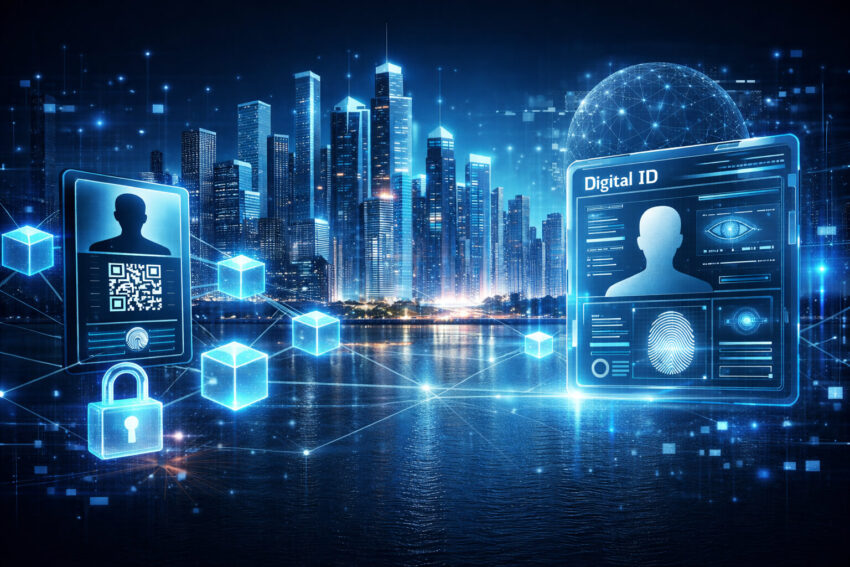
City digital identity hinges on a compact stack: DIDs + VCs + wallets, governed by registries and protocols, enabling privacy-preserving, portable access to services.
Key terms and entities:
- Decentralized Identifiers (DIDs, W3C): cryptographic identifiers (e.g., did:ion, did:pkh) resolving via a verifiable data registry (blockchain or DID network).
- Verifiable Credentials (VCs): signed data from issuers (city hall, utility, university); presented to verifiers with selective disclosure.
- SSI roles: Holder (you, via identity wallet), Issuer, Verifier; plus Trust Registry and Governance Framework.
- Protocols: DIDComm, OIDC4VC/OAuth bridges; revocation registries; zero-knowledge proofs for minimal disclosure.
- Wallets: mobile or hardware-backed; support key rotation, social recovery, guardians.
- PoP/Sybil resistance: BrightID, Proof-of-Personhood, mDL (ISO 18013-5) compatibility.
- Compliance hooks: eIDAS 2.0, LEI, KYC/AML.
Why care? Fewer forms. Less surveillance. More agency. But watch correlation, key loss, and biometric overreach.
What problems could blockchain-based digital identity solve for cities?
Blockchain-based digital identity can cut city-service friction and fraud while giving residents data control.
Why fill the same KYC forms for transit passes, library cards, housing, and permits? With SSI wallets (DIDs + verifiable credentials under W3C), you present once, reuse everywhere. Selective disclosure and zero-knowledge proofs let you prove “over 65,” “resident of Ward 3,” or “income-eligible” without exposing everything.
Think faster subsidies, utility onboarding, scooter access, parking, even e-voting and participatory budgeting—Sybil-resistant without mass surveillance. Interoperable credentials travel across departments and cities (hello eIDAS 2.0), boosting portability for students, refugees, and the unhoused.
Benefits meet accountability: cryptographic audit trails, revocation registries, GDPR-aligned consent. Environmental wins? Streamlined processes cut paper and trips.
Risks are real: key loss, exclusion, chain analytics, governance capture. Mitigations: social recovery, custodial options, offline flows, strong public oversight—not crypto maximalism, civic pragmatism.
How do DIDs, VCs, and ZKPs compose the core stack for city identity?
DIDs name you, VCs prove things about you, and ZKPs let you reveal only what’s needed—together, that’s a portable, privacy-preserving city identity stack.
[Issuer] —issues→ [VC] —held in→ [Wallet w/ DID] —proves via ZKP→ [Verifier]
(city, uni, utility) (holder) (bus, clinic, portal)
Decentralized Identifiers (W3C DIDs) give pairwise-pseudonymous handles with key rotation and recovery. Verifiable Credentials (W3C VC Data Model) carry attestations—transit eligibility, housing voucher—anchored by schemas and Status List 2021 for revocation. Zero-Knowledge Proofs (BBS+ selective disclosure, zk-SNARKs/STARKs) let you show “over 18” or “resident of District 7” without leaking name or address. Want the student fare without doxxing your GPA? Exactly.
Benefits: Sybil resistance without centralized KYC, offline-first checks via DIDComm, and inclusion for people without papers. Lower energy than blanket on-chain writes; most data stays off-chain.
Risks? Correlation if wallets reuse DIDs, key loss, coercive checks by authorities, issuer lock-in. Mitigate with pairwise DIDs, social recovery, ledger-agnostic DID methods, and open governance/trust registries.
Which architectures fit cities: public, permissioned, or hybrid chains?
Hybrid architectures fit cities best: public security + permissioned control, stitched by zero-knowledge and modular data layers.
Why? Public L1s (Ethereum, Cosmos/IBC, Polkadot) offer neutrality, auditability, and composability. Great for open tenders, carbon markets, and citizen verifiable credentials. Risk: MEV, fee volatility, governance capture by whales.
- Permissioned chains (Hyperledger Fabric, Quorum, Corda) give deterministic throughput and GDPR-friendly data residency. Ideal for land registries, utility metering, procurement workflows. Risk: weaker censorship resistance, vendor lock-in, smaller validator sets.
- Hybrid: run a city rollup (OP Stack, Polygon CDK, zk-rollups) with local KYC+DID, post proofs/data to a public DA layer (Ethereum, Celestia, EigenDA). Keep PII off-chain; attest with ZK. Interop via IBC bridges. Faster finality for buses; public settlement for microgrid carbon credits. Freedom to exit. Accountability by design. Environmental wins via transparent energy accounting.
What standards and interoperability requirements should cities mandate?
Mandate open, composable standards so no vendor can lock a city in and every subsystem can talk securely, verifiably, and privately.
– Identity and credentials: W3C DIDs + Verifiable Credentials (JSON-LD), OIDC4VP, ISO/IEC 18013-5 mDL. Why trust claims without portable proofs?
– Payments and value: ISO 20022 for rails, ILP for cross-network settlement, ERC-20/721/1155/4626 on-chain; ERC-4337 for UX. Prefer Ed25519/BLS; support threshold/MPC.
– Data and APIs: DCAT for catalogs, OGC/GeoJSON for maps, GTFS/GBFS for mobility; REST/GraphQL + event streams (WebSockets/NATS). OpenTelemetry for traces.
– Chains and bridges: IBC for sovereign rollups, CCIP as optional; DA layers like Celestia/EigenDA; OP Stack/Arbitrum Orbit/Polygon CDK for modularity.
Risk controls? ZK proofs (zkSNARK/STARK), MACI for private governance, SBOM (CycloneDX), SLSA, sigstore, reproducible builds, auditability.
Access and ethics: OAuth 2.1/UMA 2.0 for consent; WCAG for accessibility; OSI licenses, conformance test suites.
[Device] -> DID/VC -> Service (OIDC4VP) -> Event Bus -> Chain (IBC) -> DA Layer
Who are the key platforms, vendors, and open-source stacks?
Power centers are shifting to modular, open stacks, not single chains.
- Base layers: Ethereum (security + EVM gravity), Bitcoin (settlement + ordinals), Solana (monolithic speed), Cosmos SDK and Tendermint (app-chains), Polkadot/Substrate (shared security), Avalanche (subnets), Near (nightshade sharding).
- Data + availability: Celestia (DA), EigenLayer (restaking), Polygon zkEVM/Validium, zkSync, Starknet (Cairo), Scroll. Skeptical? Latency and prover costs are real.
- Rollup frameworks: OP Stack (Optimism, Base), Arbitrum Nitro, Polygon CDK, Caldera/Conduit (RaaS). Want sovereignty without bootstrapping validators? This is it.
- Infra vendors: Infura, Alchemy, QuickNode, Coinbase Cloud; node clients like Geth, Nethermind, Erigon; consensus clients Prysm, Lighthouse, Teku, Nimbus.
- Tooling: Hardhat, Foundry, OpenZeppelin, Tenderly, The Graph, WalletConnect.
- Decentralised storage and oracles: IPFS/Filecoin, Arweave; Chainlink.
- Wallets/hardware: MetaMask, Rainbow; Ledger, Trezor. Self-custody = freedom, but UX risk is on you.
- Social impact? Helium, Worldcoin, and DePIN experiments—promising, yet privacy and energy trade-offs demand scrutiny.
Where have city-scale pilots worked—or failed—and why?
Pilots work when they fix a real city pain point with clean governance and UX; they fail when they go token-first, governance-last.
Zug’s eID + tax filings and permits? Quiet win: SSI + VCs tied to existing workflows, no hype token, clear data custody. Dubai’s property registry notarization reduced fraud—narrow scope, measurable SLAs. Buenos Aires’ QuarkID on zkSync (ZK-based VCs) gives residents portable docs without leaking data. Barcelona’s DECODE proved data commons can run with citizen consent.
MiamiCoin/CityCoins imploded: misaligned tokenomics, regulatory fog, zero resident utility. Moscow’s “blockchain voting” drew audits and distrust—opaque code, questionable verifiability. Busan’s “Regulation-Free Zone” stalled amid vendor lock-in and unclear ROI.
Ask yourself: does it replace paper queues or just mint bags? Energy profile? Inclusivity vs surveillance? If the diagram looks like this, it tends to work:
Citizen → SSI wallet → VC issuance → selective ZK proof → city service
If it starts with “buy the token,” it usually doesn’t.
What are the privacy, security, and ethical risks to mitigate?
Privacy isn’t default; it’s an opt-in discipline.
Think your wallet is anonymous? On-chain metadata, timing, and dusting link identities fast. Use new addresses, privacy-preserving wallets, coin-control, and where legal, zk tools (zk-SNARKs, stealth addresses). Avoid leaking via RPC logs (don’t rely on a single Infura-like endpoint).
Security fails loud. Private keys: hardware wallets, passphrases, 2FA, and SIM-swap resistance. Prefer MPC or multisig for teams. Smart contracts: formal verification, third-party audits, bug bounties; beware reentrancy, oracle manipulation, and bridge risk—bridges remain the biggest honeypots.
Ethics and governance matter. MEV and sandwiching erode user freedom—use MEV-protected relays and intents. Guard against governance capture by whales, opaque sequencers, and OFAC-style censorship. Honor KYC/AML and GDPR; don’t dox others. Minimize biometrics; protect vulnerable users from phishing and rug pulls. Environmental? Choose efficient L2s/PoS; limit e-waste from churned hardware.
How should cities design UX, wallets, and key management for everyone?
Design for upgradeable sovereignty: start simple, let users graduate to self-custody via account abstraction and safer recovery.
One-tap onboarding with passkeys/biometrics, then “Guest → Lite → Pro” wallets. Gasless by default via city paymasters; fee abstraction in stablecoins. Why force seed phrases on day one?
Smart accounts (ERC-4337) enable spending caps, session keys, and programmable permissions for transit, utilities, and benefits. Skeptical of lockouts? Use social recovery with user-chosen guardians, time delays, and escape hatches—never default the city as a guardian.
Privacy by default: DIDs + verifiable credentials, zk-proofs for eligibility (resident, income bracket) without doxing. Consent receipts, data minimization.
Resilience matters: MPC or Shamir splits across devices + trusted humans; NFC/QR offline cards for low-end phones; multilingual, accessible UI.
Risks: guardian collusion, SIM swaps, device loss. Mitigate with rate limits, anomaly alerts, step-up auth.
Scale green: L2 rollups, batched transactions, light clients. Freedom, not friction.